
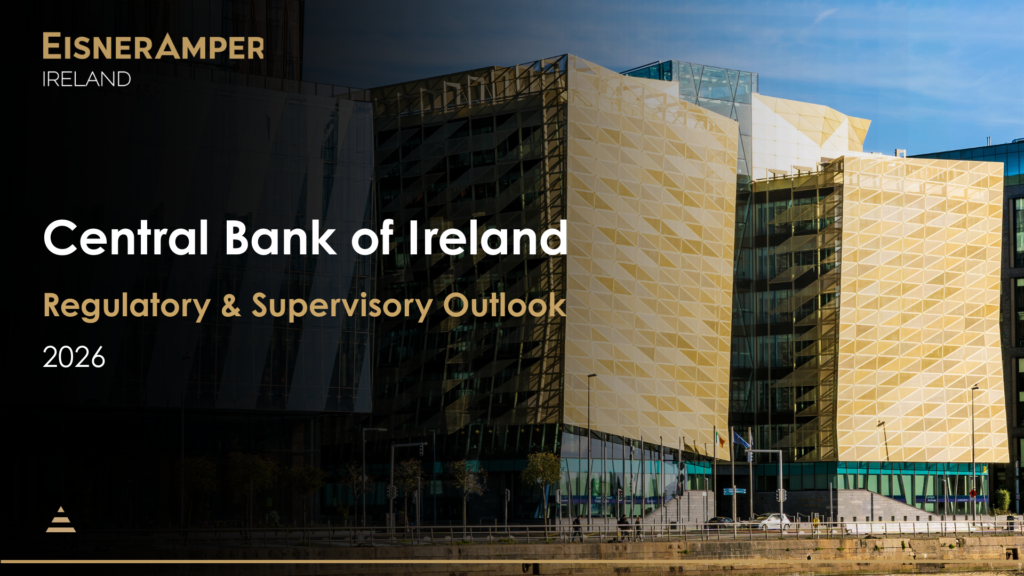
The Central Bank of Ireland has published its 2026 Regulatory & Supervisory Outlook, outlining the key risks across the financial system and the supervisory priorities that will guide its work in the year ahead.
This is the third year of the report, which is framed against a “rapidly changing international environment characterised by geopolitical tensions, macro-financial uncertainty, technological disruption and climate transition.” While the financial system is described as resilient, the emphasis is on sustaining that resilience through strong governance, effective risk management and operational preparedness.
For regulated firms, the overarching message is clear: regulatory frameworks must be fully embedded and sufficiently robust to respond to this increasingly complex risk landscape.
Below we highlight some of the key cross-sectoral supervisory priorities from the 2026 Outlook:
Operational and cyber risks remain central supervisory priorities. The Central Bank highlights the elevated risk environment arising from increasing operational complexity, accelerating digitalisation and firms’ reliance on critical third-party ICT providers.
In 2026, supervisory engagement will include Digital Operational Resilience Act (DORA) implementation, with particular reference to gaps identified in ICT risk management frameworks, governance, third-party oversight and incident reporting practices. Supervisory scrutiny will continue to centre on firms’ preparedness for operational disruption and the ability to maintain continuity of critical services.
From a financial resilience perspective, supervisory focus will remain on credit, liquidity, market stability alongside the sustainability of underlying business models. The report also highlights the growing significance of non-bank financial institutions and interconnected market exposures within the broader risk landscape.
Consumer and investor protection remains central to the supervisory agenda. The revised Consumer Protection Code (CPC), effective from March 2026, will form a central component of supervisory engagement across sectors.
Supervisory work will examine firms’ day-to-day treatment of customers, including complaints handling, management of conflicts of interest, the quality and clarity of client disclosures and products’ governance arrangements. As financial services become increasingly digital, supervisory attention will continue to focus on fraud and scam risks, as well as emerging risks in anti-money laundering and countering the financing of terrorism (AML/CFT). Preparations for the implementation of the AML Single Rule Book, together with support for the establishment of the European Anti-Money Laundering Authority (AMLA) will also be key areas of focus.
Technology-driven transformation remains a defining feature of the supervisory landscape, driven by the expanding use of artificial intelligence, digital money and tokenisation across sectors.
The Central Bank will support national implementation of the EU Artificial Intelligence Act (AI Act) and continue developing its supervisory approach to AI use across the financial sector. Supervisory activity will also include authorisation and supervision of crypto-asset service providers under the Markets in Crypto-Assets Regulation (MiCAR), alongside examination of how firms are adapting their business models and managing the risks that come with digital innovation.
Climate and environmental risks continue to shape the longer-term supervisory agenda. The Central Bank will examine whether climate risk is meaningfully embedded in firms’ governance, risk management and strategic planning, covering both the physical impacts of climate change and the transition risks associated with a move to a low-carbon economy.
The 2026 supervisory agenda points to continued attention on operational resilience and ICT risk management, particularly in the context of DORA. Firms should ensure readiness for the revised Consumer Protection Code, review governance arrangements around AI and emerging technologies, confirm that AML/CFT controls remain aligned with evolving EU reforms and ensure climate risks are appropriately reflected in risk management and business model planning.
Strong governance, effective risk management and clear board oversight remain central to the Central Bank’s expectations across all sectors, including evidence of how firms have embedded the Individual Accountability Framework and SEAR.
EisnerAmper Ireland’s Governance Risk and Compliance team works with regulated firms at every stage of the regulatory lifecycle, from authorisation through to ongoing supervisory engagement. We closely monitor regulatory developments, including the Central Bank’s annual Regulatory and Supervisory Outlook, as part of our commitment to ensuring clients remain informed, prepared and resilient.
If you would like to discuss how the 2026 supervisory priorities impact your firm, please get in touch.

 +353 1 293 3400
+1 212 949 8700
+1 345 945 5889
+65 6305 9900
+353 1 293 3400
+1 212 949 8700
+1 345 945 5889
+65 6305 9900
