

Financial Resilience Is No Longer Optional. It Is Strategic.
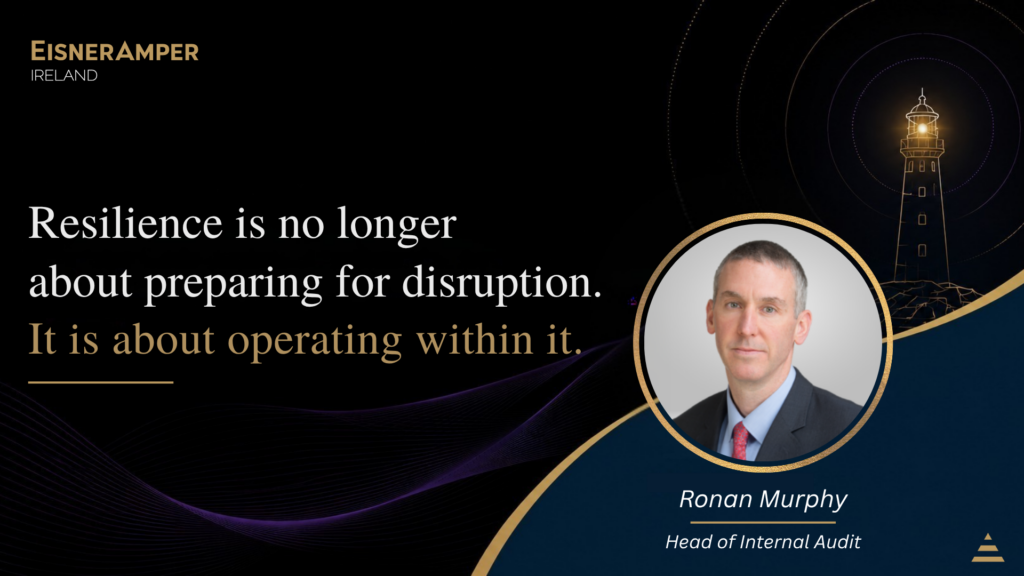
In today’s environment, uncertainty is not a disruption to normal business conditions. It is the operating environment.
Geopolitical instability, macro-financial volatility, market disruption, cyber threats, and operational risks are no longer episodic. They are continuous, interconnected, and increasingly complex. Risks that once emerged gradually can now materialise within weeks, reshaping market conditions, client behaviour and business performance.
For Irish MiFID firms, this reality is reflected clearly in the Central Bank of Ireland’s 2026 supervisory priorities, with a strong emphasis on maintaining and strengthening resilience to geopolitical and macro-financial risks.
Against this backdrop, financial resilience has evolved from a focus on regulatory compliance and capital adequacy to a broader capability: the ability to
withstand shocks, adapt quickly, and continue operating in a safe and orderly manner without compromising clients, markets, or long-term viability.
From Compliance to Capability
Historically, resilience was often viewed through a narrow operational lens such as business continuity plans, system availability, and disaster recovery arrangements.
While these remain important, today they are no longer sufficient on their own.
Financial resilience sits at the core of a firm’s ability to function under stress. Without it, firms cannot effectively:
- Absorb prolonged revenue shocks
- Manage liquidity pressures
- Maintain client confidence
- Respond strategically to disruption
In many respects, financial resilience underpins every other form of resilience.
Crucially, regulators are increasingly assessing resilience not just through financial metrics, but through the quality of governance, the credibility of planning, and the strength of the decision-making frameworks that support firms through periods of uncertainty.
What Firms Are Telling Us
During a recent webinar hosted by EisnerAmper Ireland in conjunction with the IMIA, we asked participants about the maturity of their financial resilience frameworks.
The findings reveal a sector that is highly aware of emerging risks and actively engaged in addressing them but still progressing towards fully embedded resilience capabilities.
- Board engagement is improving but not yet dynamic.
Encouragingly, most firms reported that their Boards have considered geopolitical risk within the past year, with many doing so in the previous six months.
This represents meaningful progress. Boards increasingly recognise that geopolitical developments are no longer peripheral concerns; they are material drivers of financial performance, strategic risk and organizational resilience.
However, the findings also raise an important challenge.
In today’s environment, risk profiles can change rapidly. Energy market volatility, interest rate movements, cyber incidents, trade disruption and geopolitical conflict can alter a firm’s financial outlook in a relatively short period.
As a result, resilience requires more than periodic review. It requires continuous
oversight, challenge and recalibration.
The most resilient firms are moving beyond annual risk discussions and incorporating resilience considerations into regular Board decision making and strategic planning.
- Awareness is high, but embedding remains limited.
When firms were asked whether they had updated their ICAAP or ICARAP frameworks to reflect geopolitical developments, a clear pattern emerged.
While a small number of firms have fully embedded resilience considerations into their operating models, many remain in earlier stages of maturity. Some are still
- Exploring the impact
- Running limited pilots
- Or implementing changes in specific business areas only
This gap matters.
ICAAP and ICARAP processes are intended to be dynamic, forward-looking, and integrated into strategic decision-making. Yet for many firms, they continue to operate primarily as annual regulatory exercises rather than living management frameworks.
The result is often a disconnect between recognising risk and responding to it in a structured and enterprise-wide manner.
As supervisory expectations continue to evolve, this gap will become increasingly difficult to sustain.
The Real Risk: Strategic Drift
One of the most important and often underestimated insights from this discussion is that financial fragility rarely arises from a single event.
More often, it stems from gradual strategic drift, including:
- Overreliance on a small number of clients or revenue streams
- A cost base that cannot flex under pressure
- Business plans based on outdated market assumptions
- Slow or ineffective decision-making processes
- Insufficient challenge around emerging risks
Individually, these issues may appear manageable. In stable environments, they may go largely unnoticed.
However, in stressed conditions, they can quickly become critical vulnerabilities.
This is why financial resilience cannot be treated as a compliance exercise alone. It requires strategic honesty and a willingness to challenge the long-term sustainability of the business model, not simply its regulatory position.
What ‘Good’ Looks Like
The direction of travel from regulators is unambiguous.
Stronger firms are already moving beyond baseline compliance and demonstrating a more mature approach to resilience through:
- Active Board ownership of financial resilience, supported by regular and data-driven challenge
- Severe but plausible stress testing that informs real business decisions
- Robust liquidity management, including forward-looking cash flow analysis and contingency planning
- Integrated resilience frameworks linking financial, operational, and strategic risks
- Credible recovery and wind-down planning grounded in realistic scenarios
- Clear management information that supports timely and effective decision making
Importantly, these firms are not attempting to predict the future perfectly.
Instead, they are building the capability to respond effectively regardless of what the future brings.
Turning Resilience into Competitive Advantage
Resilience is often viewed through a defensive lens, something necessary to satisfy regulatory expectations and avoid adverse outcomes.
That perspective overlooks a significant strategic opportunity. Firms that invest meaningfully in financial resilience are better positioned to:
- Navigate volatility with confidence
- Maintain and strengthen client trust
- Act decisively when competitors cannot
- Capitalise on market dislocations when competitors are constrained
In an uncertain environment, resilience becomes more than a protective mechanism. It becomes a source of competitive advantage.
Where Firms Go from Here
The findings from our discussion point to a clear conclusion.
The industry is moving in the right direction, but many firms have not yet reached full maturity.
The challenge is no longer awareness. It is execution.
Embedding financial resilience requires a structured and end-to-end approach that connects governance, risk management, capital planning, liquidity management, and business strategy within a coherent framework.
It also requires firms to move beyond static assessments and adopt a more continuous, forward-looking approach to decision-making.
How EisnerAmper Ireland can help
As firms seek to strengthen their resilience capabilities, an objective assessment can help identify gaps, prioritise actions and align resilience planning with both regulatory expectations and business strategy.
EisnerAmper Ireland supports Irish MiFID firms in designing, assessing and embedding financial resilience frameworks aligned to:
- Central Bank of Ireland expectations
- ESMA guidance
- MiFID II, IFR and IFD requirements
Our support typically focuses on two key areas.
- Benchmarking and Diagnostic
We assess the current state of your financial resilience framework across:
- ICAAP and ICARAP frameworks
- Stress testing and scenario design
- Liquidity risk management
- Governance and Board oversight
- Recovery and wind-down planning
This provides a clear view of how resilience is currently documented, understood, and applied in practice.
- Actionable Implementation
We work with firms to develop prioritised and practical action plans that:
- Address identified gaps
- Strengthen forward-looking risk management
- Enhance Board reporting and decision-making
- Integrate resilience considerations into strategic planning
Our focus is on helping firms move from intention to implementation and from compliance to capability.
Final Reflection
The question facing firms today is not whether disruption will occur.
It will.
The real question is whether firms are prepared,
financially, operationally, and strategically, to withstand it.
Those that are will do more than survive periods of uncertainty.
They will be positioned to lead through them.
If these challenges resonate with your firm, now is the time to move from reflection to action and assess whether your resilience framework is truly prepared for an increasingly uncertain environment.
To continue the conversation, please contact:
Ronan Murphy, Partner, Head of Internal Audit – Ronan.Murphy@eisneramper.ie or +353 1 2933 432
Frank Keane, Partner, Governance, Risk & Compliance – Frank.Keane@eisneramper.ie or +353 1 2933 450

